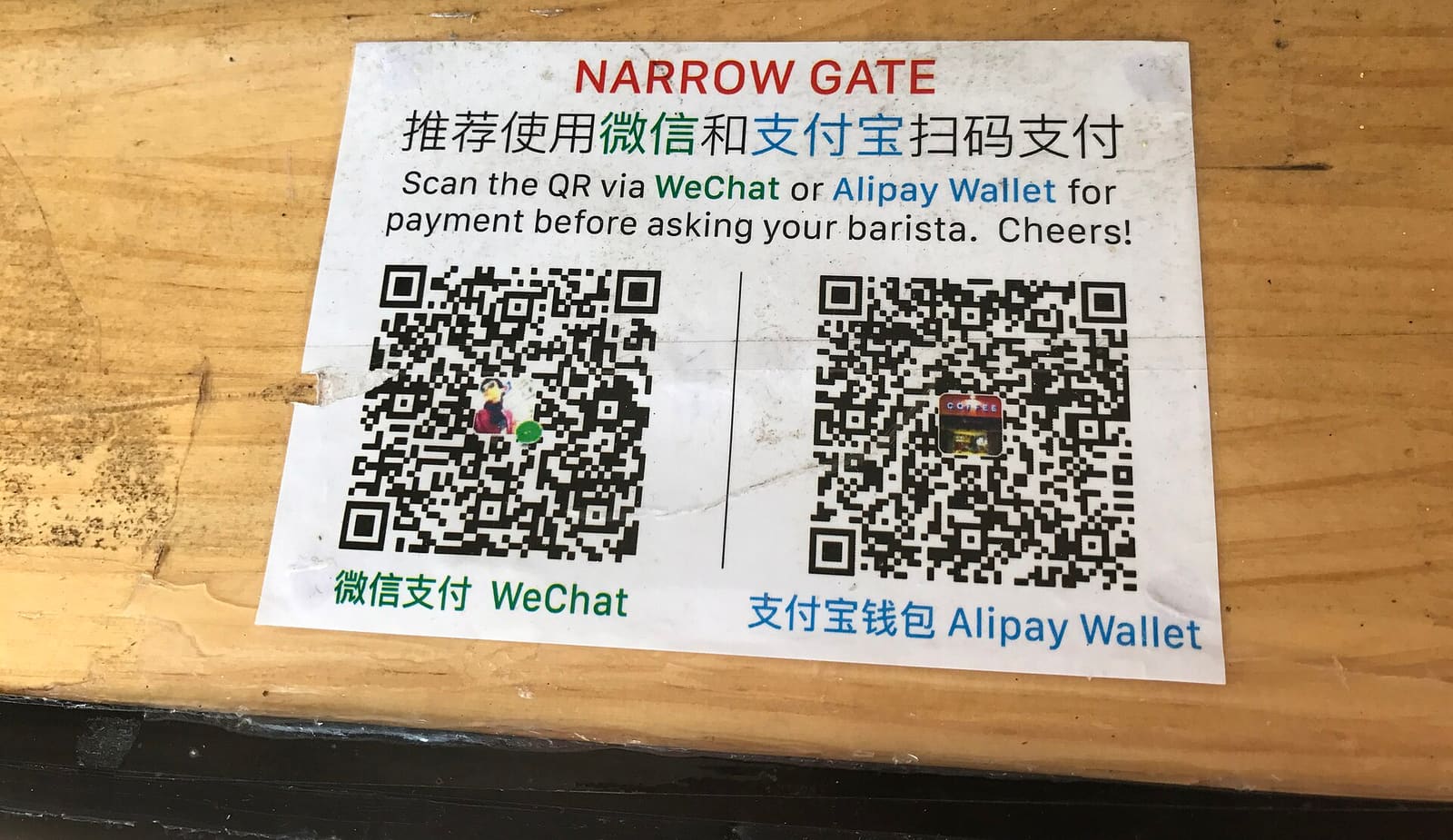
Mobile payments: Alipay and WeChat Pay
China is a near cashless society. Alipay and WeChat Pay now accept foreign Visa, Mastercard, JCB and other international cards. Download the app, register with your passport, and bind your card—most travellers finish in about 10 minutes. You can then scan QR codes to pay at restaurants, shops, taxis and metro gates. Add a photo of your passport and verify your phone number for a higher payment limit. If setup fails, airport kiosks in Beijing, Shanghai and Xi'an offer on-site help.
When cash and cards still matter
Carry some Chinese yuan in cash. You'll need it at street markets, temple donation boxes (功德箱), roadside stalls, and some rural guesthouses that don't take cards. Credit cards (Visa, Mastercard, Amex) are accepted at four- and five-star hotels, large shopping malls and international restaurant chains, but most small shops, cafés and local eateries cannot process them. Always ask "可以刷卡吗?" before ordering if you plan to pay by card.
Getting cash from ATMs
If you run low, withdraw at an ATM inside a bank branch. Look for the UnionPay (银联) or Visa/Plus logo. Foreign cards usually work; a single withdrawal is capped at about 2,500–3,000 yuan. Decline the ATM's "currency conversion" offer and let your bank do the exchange for a better rate. Keep small notes—vendors often can't break 100-yuan bills.
Internet access: what's blocked and how to connect
Google, WhatsApp, Instagram and Facebook are not accessible in mainland China, and many Western apps and news sites are throttled or blocked. Three options: (1) International roaming eSIM from your home carrier—recommended first choice, works out of the box on landing, keeps your usual apps. (2) A VPN—stability is poor and you must research its compliance yourself. (3) Download offline maps and translation apps before you fly. Recommended apps: Alipay, Didi for taxis, Amap (Gaode) or Baidu Maps, Pleco Chinese dictionary, and Google Translate's offline language packs.
Common questions
Can I survive in China without Alipay or WeChat Pay?
You can, but it's hard. Cash works at markets, temples and some small shops, and cards work at hotels and malls. But many taxis, street vendors and ticket machines are QR-only. Setting up Alipay with a foreign card takes about 10 minutes and removes almost all friction—strongly recommended.
Can I use Uber in China?
No. Uber sold its China business in 2016 and the app no longer operates there. Use Didi (the local equivalent, with an English interface and foreign-card payment) or Baidu Maps / Amap to hail a ride. For short trips, metros in major cities are cheap, clean and English-signposted.
Do I need a VPN to use the internet in China?
Only if you rely on Google, WhatsApp, Instagram or Facebook. For maps, taxis, translation and payments, the local apps above work without a VPN. If you need your usual Western apps, an international roaming eSIM is the most reliable solution; a VPN is a secondary, less stable option.
Official sources
- People’s Bank of Chinapayment systems and mobile payment
- Ministry of Industry and Information Technologytelecom and internet access
Tours
Written and re-verified by our local team.