The eight great cuisines, in one page
Chinese cooking divides into eight regional families. Sichuan and Hunan are the famous spicy pair — Sichuan numbs (huajiao pepper), Hunan simply burns. Cantonese and Jiangnan cooking are about freshness and subtle sweetness. Shandong is the north’s hearty, savoury root; Fujian and Anhui are soup and mountain-food traditions; Zhejiang overlaps Jiangnan with a lighter touch. On a first trip you will most likely meet Sichuan, Cantonese and Jiangnan — order each region’s signature and you have the map.
How to order like a local
Dishes arrive when they are ready, all shared from the centre of the table. The local formula is roughly one dish per person plus a soup and a staple — rice or noodles. Under-order rather than over-order; you can always add. Tea is poured for the table, and it is polite to tap the table with two fingers when someone pours for you. At hotpot restaurants the bill comes with the pot; at street-food stalls you usually pay at the door.
Dietary needs: vegetarian, halal and allergies
Vegetarian food is easy and often excellent — Buddhist vegetarian restaurants cook elaborate mock meats from tofu and wheat gluten, and most Chinese kitchens will happily cook vegetable dishes without meat stock if you ask explicitly, because chicken stock is common. Halal (qingzhen) restaurants run by Hui communities are widespread in Xi’an, Lanzhou and Xinjiang. Peanut, sesame and shellfish allergies need written translation cards; our guides carry them and brief restaurants in advance.
Street food, water and hygiene
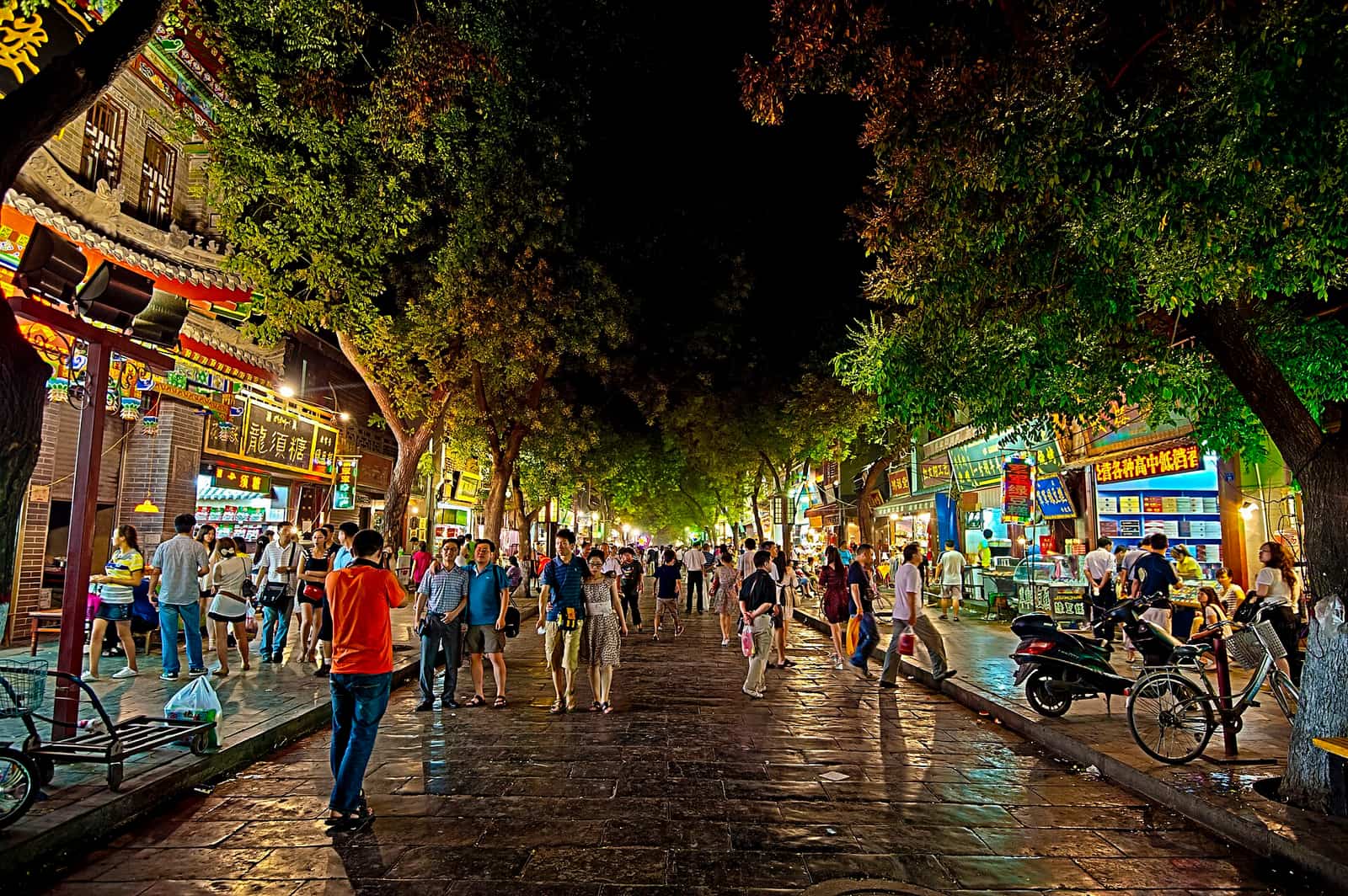
Street food is the highlight of eating in China — choose stalls with a queue of locals and food cooked in front of you. Ice in restaurants is usually made from treated water, but skip unknown tap water everywhere: bottled or boiled only. Fine-dining rooms and hotel restaurants are as hygienic as anywhere in the world; markets are the place to be adventurous.
What a meal costs
A street-food lunch is US$2–5; a neighbourhood restaurant dinner US$8–15 per person; a banquet-style meal with Peking duck or a whole fish US$20–40. Hotpot for two with drinks runs US$15–25. Tipping is not customary anywhere in China.
Common questions
Will I be able to eat with a nut allergy?
Yes, with planning. Peanut oil and sesame appear in Sichuan and northern kitchens especially. Carry a translated allergy card, eat at sit-down restaurants rather than street stalls, and tell your guide on day one — we brief every kitchen on your route.
Are chopsticks and shared plates really universal?
Shared plates, yes — communal dishes are the norm, with individual rice bowls. Chopsticks are standard, but forks and spoons are available everywhere; asking costs nothing.
Can I drink the tap water, or brush my teeth with it?
Do not drink it — bottled or boiled water only. Brushing teeth is fine for most visitors. Hotels provide bottled water, and we refill your flask daily on tour.
Official sources
- Ministry of Culture and Tourismregional cuisine listings
Tours
Written and re-verified by our local team.